Thirty years of field questions
Straight answers about concrete.
The questions homeowners actually ask, answered clearly by the Page Concrete team.
Materials · cure · care · honest answers
Concrete FAQ
What is cement and concrete?
Cement and concrete often are used interchangeably. However, cement is actually an ingredient of concrete. Concrete is a mixture of sand, gravel or crushed stone, a paste of water and Portland Cement. Cement comprises from 10 to 15 percent of the concrete mix, by volume. Through a process called hydration, the cement and water harden and bind it all into a rocklike mass. This hardening process continues for years, meaning that concrete gets stronger as it gets older.
How long does it take for concrete to cure?
Concrete typically fully cures within 28 days. After 2 days it is acceptable to walk on, and after 7 days it is acceptable to drive on.
What is Fibermesh?
This is a concrete additive that is mixed in with the cement at the ready mix plant. If you could look at a cross section of Fibermesh fibrous concrete, you would see millions of polypropylene Fibermesh fibers uniformly distributed in all directions throughout the concrete mix. These fibers provide top-to-bottom, side-to-side uniform reinforcement and are a cost-effective and superior alternative to wire mesh reinforcement. We use Fibermesh in all of our concrete mixtures.
How thick should my concrete be poured?
In this region of High Point, NC, proper concrete thickness is essential for long-term performance given local clay soils and freeze-thaw cycles. Residential driveways are typically poured at 4 inches for durability under standard vehicle loads. Driveway aprons, which handle concentrated turning stress at the street transition, are required to be 6 inches thick per municipality codes. Commercial pads generally require 6-8 inches or more, depending on expected traffic and equipment loads.
Does concrete have to be gray?
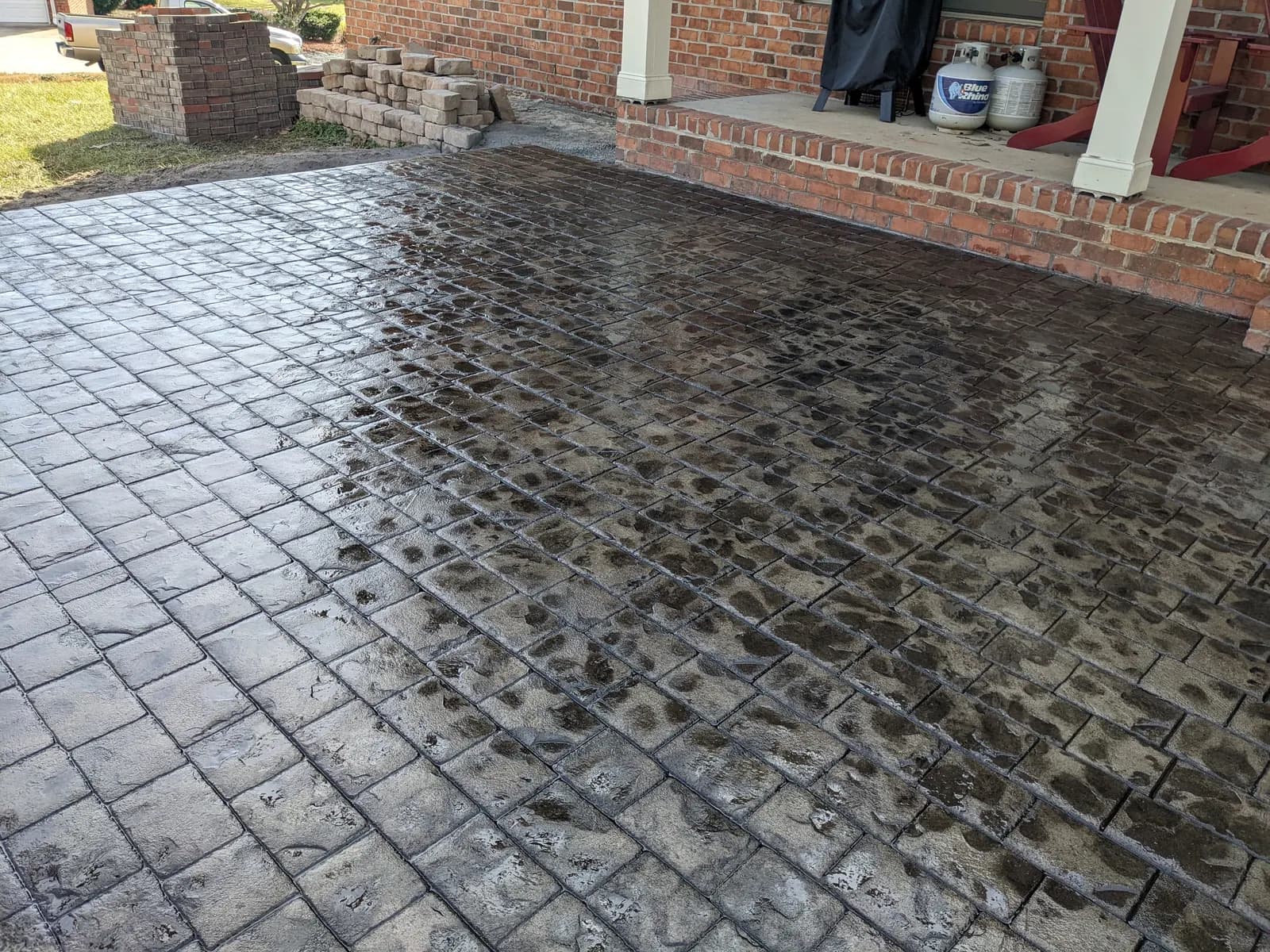
Not at all. There is an almost limitless palette of special finishes for concrete colors. With the addition of an integral color and a skilled decorative concrete contractor (the Page Concrete Team), concrete can take on almost any shape, pattern, color or texture, in both exterior and interior applications. Stamped concrete is a great option, or a broom finish with a single integral color.
How long does it take before I can drive on a new driveway?
In our market area, the American Concrete Institute and the American Concrete Pavement Association recommend a minimum of seven (7) days following concrete placement before using a concrete driveway.
How long does it take before I can walk on my new concrete?
We recommend not to walk on new concrete for three (3) days.
Is the process of installing concrete affected by weather?
Yes it can be affected. The rate at which concrete hardens is very much affected by temperature, moisture and wind. Wind can cause the surface to crack. Rain can significantly weaken the surface. Placing concrete in cold weather often involves heating some of the concrete ingredients and protecting the freshly-placed concrete from freezing with insulated blankets. Placing concrete in hot weather might mean cooling materials or adding ingredients to slow the curing of the concrete.
Will concrete crack?
Yes, concrete does crack. To minimize and control cracking, control joints are placed in the concrete so that the concrete cracks where those control joints are placed. These are either hand control joints or saw cut control joints. There is no guarantee that concrete will not crack in other places. Mother nature is ultimately in control of concrete cracking.
Is there a recommended on-going maintenance program for my concrete?
In addition to sealing concrete every 2–3 years:
- Do not allow rusting metals to sit on the concrete.
- Frequent sweeping and occasional hosing will be enough to keep your concrete looking good. Wet leaves on a driveway have a tendency to stain, so be prepared to clean your driveway often in fall.
- Do not allow water to drain beneath the slab. Settlement cracks may develop.
- Do not allow snow and ice to accumulate the first winter. Keep the driveway shoveled off.
- Do not apply deicing chemicals for snow and ice removal the first winter. As an alternative, sand can be used for traction.
- WARNING: Never use deicers containing ammonium sulfate or ammonium nitrate (i.e. fertilizers). Such products are known to aggressively attack concrete.
What strength of concrete do we use?
While standard codes call for 3,000 PSI concrete, the Page Concrete team elevates every project with proven processes and systems. We use 4,000 PSI concrete with fiber reinforcement for residential work and 5,000 PSI with fiber reinforcement on commercial projects—delivering superior strength and lasting performance.
How are concrete and asphalt different?
Concrete offers greater versatility than asphalt, performing well both outdoors and indoors—including decorative applications. It also lasts longer and requires less maintenance. A concrete driveway can last up to 30 years, compared to roughly 12 years for asphalt, and needs far less maintenance. Highly durable, concrete withstands heavy traffic, making it ideal for freeways, intersections, and of course all your residential needs.
Question about a specific job?